
COLUMN: Birdsongs In The Storm
old enough to remember; wise enough to keep listening and learning
Dan Lyksett, illustrated by Sarah Ryan |
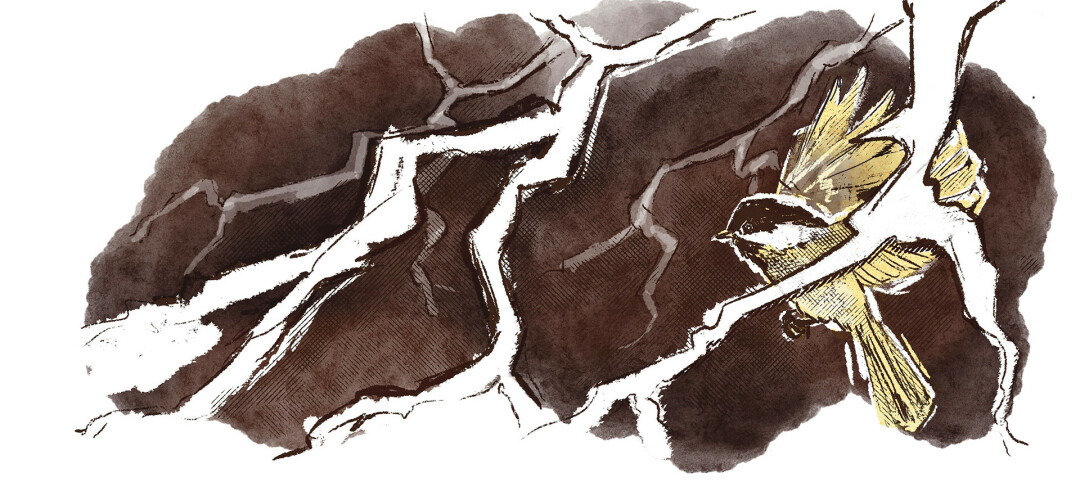
Early morning, Jan. 25, 2026. I get up, put coffee on and go back to bed, burying myself deep into the warmth beneath the quilt. I lay on my back, counting the moments before the beep beep beep of the coffee pot announces the brew is ready, and I must arise and prepare to meet a world I think may be going mad.
But before the coffee pot can speak, I hear a single sound; a peep, coming from outside the window, open just a crack to allow in fresh air. (I say “open just a crack” because it’s 23º below zero outside.)
And there it is again: A single peep. I think I know what it is but can’t quite believe it. I grab my phone, open the Merlin bird identification app and hold the phone out the window.
Peep. Merlin hears it too. Peep.
Merlin confirms: It’s a black-capped chickadee. Birders refer to it as a “tweet,” a call chickadees make year-long to let other chickadees know where they are. But on this morning, with the thunder clouds of a troubled world just over the horizon, those single notes in the frozen stillness of a winter dawn will become a refuge for me.
As I write this, I have friends who are hurting, who are frightened, who are angry. I have friends who want to gather what they can and run from the thunderstorm. A part of me is with each of them.
”
FRANCES TOLD ME SHE THOUGH I WOULD DO FINE, BUT I NEEDED TO BE READY FOR HARD TIMES.
She said I couldn't help anyone if I didn't take care of myself. She said when I felt it becoming too much, I should step back. When necessary, forgive myself. Give myself some grace.
I am old enough to have a certain perspective on this storm, these tragedies. As a high school senior, I helped organize a protest over four dead in Ohio. As a college student I tasted tear gas. And I got drunk on cheap wine the night Nixon announced we’d mined Haiphong Harbor, convinced we were one sunken Soviet freighter away from a nuclear war.
Maybe that’s why I heard what I did in that bird song. It comes from a lesson I learned a long time ago.
Back in what seems like a previous life, I worked in a treatment center for kids with emotional disturbances. I held several different roles, but the duties of my last position included supervising childcare workers. A large percentage of those workers were college students; young adults still in the process of figuring out who they really were. They were, on the whole, good people, dedicated and trying their best to make a difference in the world.
Their work could be rewarding, but it could also be stressful. Occasionally I would see someone struggling. Perhaps they had been disappointed, or worse, had disappointed themselves. When I had to help someone through a rough time, I often fell back on a lesson I’d learned from the woman who had trained me for my first job at the center.
Frances was older, a farmer’s wife working an off-the-farm job. To call her “salt of the earth” is to speak truth. Toward the end of her tutorship, she sat me down for a chat. Frances told me she thought I would do fine, but I needed to be ready for hard times. She said I couldn’t help anyone if I didn’t take care of myself. She said when I felt it becoming too much, I should step back. When necessary, forgive myself. Give myself some grace.
It’s a lesson I carry with me. It’s a lesson that I used that January morning.
As hard as I try, I can’t see the chickadee. But I can hear it, that single note, about every 30 seconds. It is not a plaintive call. No notes of distress or alarm. It is a song. A simple, one-note song, but a song nonetheless.
For that brief moment in the bitterly cold January dawn, the simple song of a tiny bird drowns out the thunder of the growing storm. And I give myself permission to listen.