
COLUMN: Collagraph Printing Gains Interest In The Valley
Noriko Slowinski of the Valley Art Association dives into process of relief, intaglio printing and more
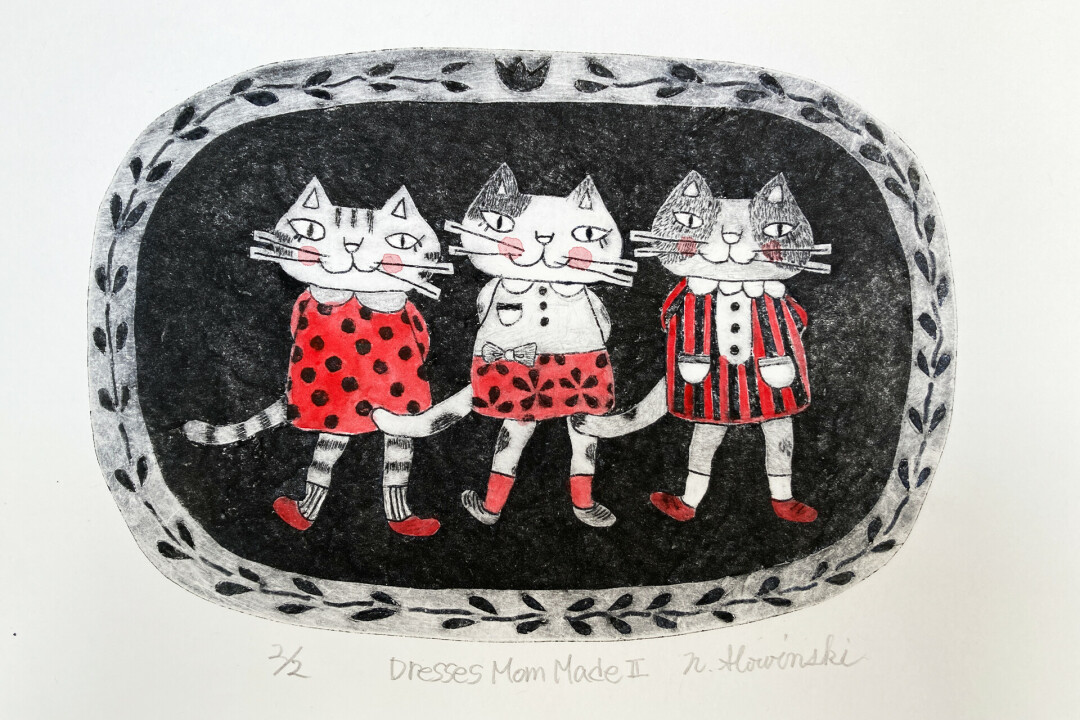
The art of printmaking has deep historical significance throughout time and today, art enthusiasts and beginners in the Chippewa Valley are curious to learn the basic processes.
As printing workshops continue to pop up locally – from the Eau Claire public library to local downtown businesses – I met with Noriko Slowinski, a Valley Art Association member, to learn more about her specialty: collagraph printing.
Many creatives would agree printmaking techniques can be done through four main categories: relief, intaglio, planographic and stencil.
Relief printing: Often associated with woodcuts or linoleum carving, this method involves creating raised surfaces by carving into the material. Then, ink is applied to the surface.
Intaglio printing: In this method, a metal surface is either engraved into or chemically etched. The ink sits in the grooves of the original image or shapes created. Ink is then wiped off and when pressed into paper, only the etched grooves appear.
Planographic printing: Referred to as lithography or monotype, this process is done without engraving the surface. Instead, through chemical treatments on the surface, ink is applied and the image or shape – often made with grease pencils – appears.
Stencil printing: Commonly recognized as screen printing, this process involves forcing ink through a cut out shape or area onto a new surface.
Collagraph printing, Slowinski said, is unique as it can combine both relief and intaglio elements. Artists are drawn to it because they can use inexpensive, everyday materials – such as thin cardboard boxes. It is experimental and allows artists to explore textures and patterns within their work.
“Because my kitchen is my art studio, I’m afraid to use the chemicals that are used in other forms of printmaking, so collagraph printing was interesting to me,” Slowinski said. “Now, I’d like to introduce it to the local art community. I think other people will also enjoy the process.”
Her process is simple. First, she creates a sketch of what she would like to print. Then she obtains the carving material. She orders special paper for this from Japan, but the process can also be made on the back of a thin cardboard cereal box found in recycled materials.
The design is transferred onto the carving surface using basic carbon paper onto the shiny side. Using a sharp craft knife, she carves the lines of the design and then carefully peels away just the top layer of the surface to reveal a recessed area.
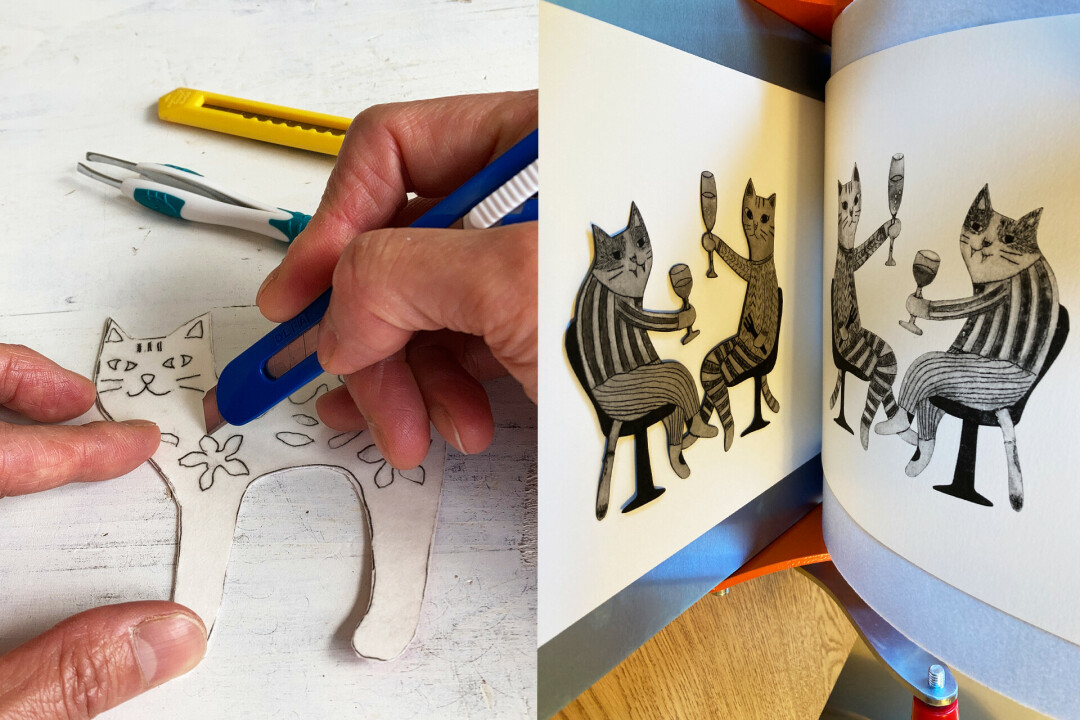
Care must be taken to not press too deep and cut through completely. Lines can also be scratched and crosshatched into the surface to create various textures.
If she wants a grayscale, she uses sandpaper to rough up the shiny surface. A varnish shellac can be applied to protect the paper. When dry, ink is applied to the carving then covered with rice paper before they are put through a rolling press.
The surface can only be re-inked a few times before the edges get blurry and it begins to deteriorate, so the number of collagraphs created from one carving is always limited.
Slowinski will soon offer a collagraph printing workshop from 10am-2pm, on July 25 at Decadent Gifts and Gallery (329 Water St., Eau Claire).
As she continues to impart these printing methods to others in the community, she hopes to find other curious artists, who may want to develop a larger printmaking collective in the Chippewa Valley.
Locals are encouraged to reach out to Slowinski via email at artriko@outlook.com to learn more about the process of collagraph printing and coordinate future classes and events.
“Behind the Easel” is a periodic column by Patricia Hawkenson, a visual artist and one of the proprietors of Decadent Gifts & Gallery in Eau Claire.