COLUMN: The Five Stages of Smartphone Ownership
Denial, anger, bargaining, depression, then acceptance. In that order.
Dan Lyksett, illustrated by Sarah Ryan |
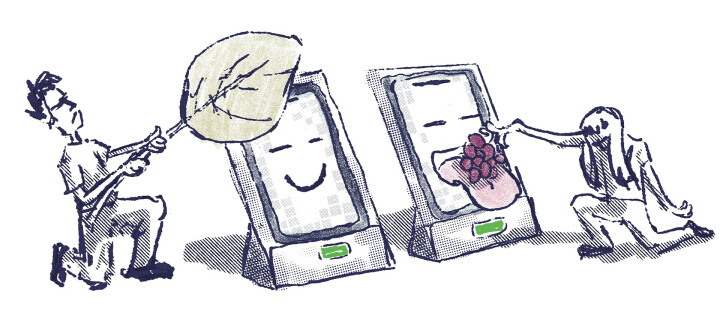
Dan Lyksett, illustrated by Sarah Ryan |
I came late to the world of cell phones. Thought I didn’t need one. Knew I didn’t want one. I liked being unreachable.
I suspect it had to do with my childhood. I was the youngest child, the only boy with two older sisters. Our parents’ work schedule dictated they were often my keepers, which meant I was often within their reach. I’m still recovering.
But I should have known a cell phone was inevitable. I’d been tipped off some 25 years ago when I attended a weeklong workshop on “New Media” at the University of California at Berkeley. We were a dozen or so journalists from across the country. Only one of us, a reporter from the Washington Post, had a cell phone. Not a smart phone, just a cell phone.
One of our workshops was presented by a futurist who taught at the university. He said he understood why we were all so focused on building efficient and attractive websites. That was the future!
So we thought. The futurist suggested an alternative. Think about a woman today getting on the bus or the trolley, he said, newspaper tucked under her arm so she can catch up on the news as she heads to work. Now imagine instead of a newspaper she has a sheet of something impregnated with some sort of magnetic ink that refreshes each day with the newest news. Or maybe it’s a small device she keeps in her purse that she can pull out, turn on and access anything she wants to know.
The future, it seems, was the smart phone.
I was doing just fine without one, thank you, until one day I returned to the office to find a small box sitting on my desk. Inside was a smart phone. On the outside was a note from my boss. It read: “Use it.”
”
The genie is out of the bottle. It should serve us, not the other way around.

DAN LYKSETT
I liked having a job, so I girded my loins and turned the thing on. Or more accurately found someone to show me how to turn it on. So began my journey into the five stages of smart phone ownership.
Denial: I already tried that. Like I said, I liked having a job. So …
Anger: I quickly discovered learning to type with my thumbs was harder than learning to ride a bike, make a decent cup of coffee and memorize the proper responses in a Latin mass, all at the same time.
Bargaining: Once I became proficient with the phone, I moved straight into addiction. So much news from the far reaches of the planet. So many long forgotten former friends sharing vacation photos. And the kitties!
I realized my addiction was not sustainable. I had to eat. I began rationing my online time, focused on necessary communication (e.g. My wife also has a phone) and apps I found truly valuable. (Weather forecasts, maps and Merlin for bird identification). Back away from the social media stuff.
This helped for a while, but then …
Depression: Go ahead, try living without all those “This is us wintering in Scottsdale this year” photos. All the birthdays I missed liking or smiley facing or something, even those for people I’d pretty much forgotten had even been born. No, I didn’t see the video of the kid bouncing his little brother up and over the trampoline netting.
And all the kitties!
Acceptance: Nope. Not yet. At the risk of sounding like a curmudgeon, I still have work to do.
As Yogi Berra once said, “You can observe a lot by watching.” How often do you see people at a concert or a sporting event who are right next to the action but are staring at the phones they hold high above their heads like a talisman? They’re focused on creating a digital record of the experience rather than immersing themselves in the experience itself.
I also too often reach for my phone to supplement my life rather than just living it. If I’m hiking, do I really need to track my steps with the pedometer app? Is a photo of the swans’ delicate reflection in the pond necessary rather than just admiring how the image pulses with the waves? Must I reach for my phone to check on this or that or some other thing while taking a break on a park bench instead of just sitting and being?
I fear for the young, the children, teenagers and young adults who don’t really know a world without the instant gratification that smart phones provide. Bored? There’s a game for that. Lonely? Open your social app of choice. Need knowledge? Google it.
The genie is out of the bottle. It should serve us, not the other way around.

PUBLISHER / EDITOR / OWNER
Nick Meyer
Staff • Contributors • Careers
Have questions? Email us: • editorial@volumeone.org(Editorial,) • web@volumeone.org(Website,) • manager@thelocalstore.org(Store,)
Terms of Use / Privacy Policy | ©2002-2026 Copyright Volume One Magazine