THE LANDFILL LIFESPAN: What Long-Term Solutions Come Next?
County staff to explore waste-to-energy infrastructure and more after GFL's landfill expansion request voted down
Evelyn Nelson, photos by Andrea Paulseth |
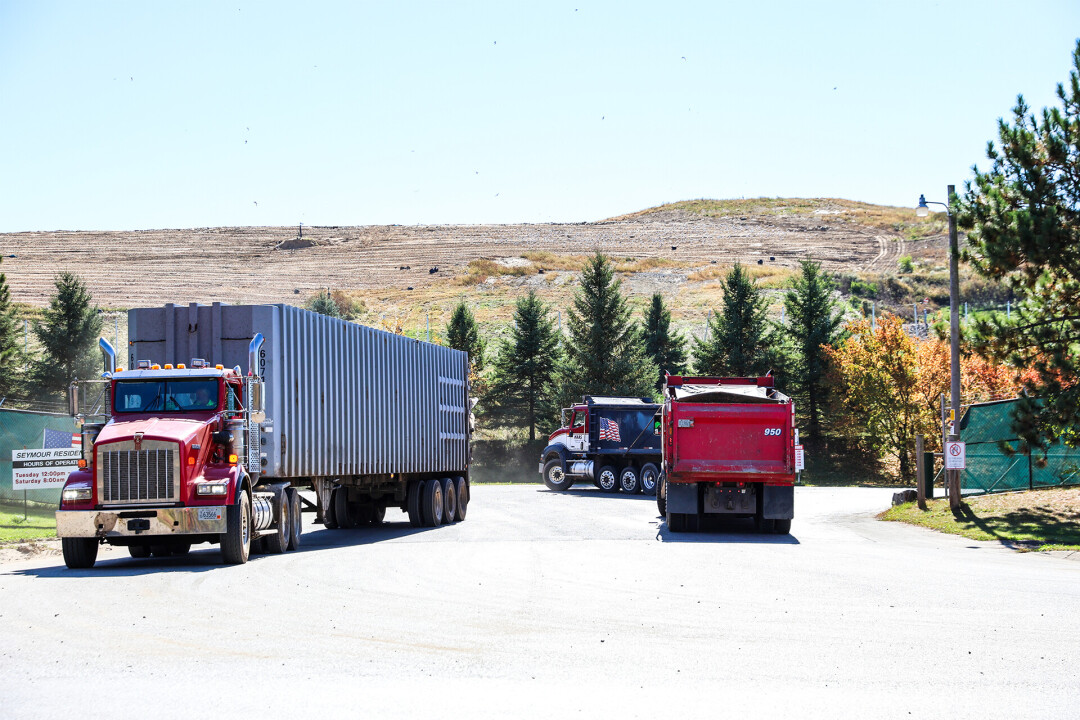
On Monday, Oct. 26, the Eau Claire County Parks and Forest Committee unanimously voted to deny Green For Life (GFL) Environmental’s request to purchase 120 acres of county forest for its future landfill expansion.
This parcel of land was the focus of a recent proposal to expand the Seven Mile Creek Landfill (8001 Olson Dr., Eau Claire), which would have increased its lifespan by 15 years.
While committee members were united in their rejection of the operator’s bid to acquire public acreage for its expansion, there’s still the question of what to do once the landfill reaches its capacity in the next decade.
During the Oct. 26 committee session, a new county assessment report detailed GFL’s proposal and considered its environmental and economic implications.
From there, the committee was presented with three options: Decline action and withhold county forest land from sale; Commission an evaluation to report parcel valuation and total acreage back to members; Form a working group to study wider community impacts.
By selecting the first option, denying GFL's bid, the county forest acreage will remain under public ownership; County staff will not initiate an appraisal or broader transaction analysis at this time.
Yet, as Director of the Eau Claire County Parks and Forest Division Josh Pedersen said, “there needs to be some sort of a solution to (waste management) for the long term.”
Pedersen noted the landfill already owns an additional 80-acres of land – purchased from the county prior to when the facility was sold to GFL by former owner Advanced Disposal in 2020 – that it can develop to extend the lifespan of the Seven Mile Creek Landfill.
“there needs to be some sort of a solution to (waste management) for the long term.”
josh pedersen
director, Eau Claire County Parks and Forest Division
Plans to do so are currently going through a permitting and review process, Pedersen said, with involvement from the Wisconsin Department of Natural Resources (DNR).
As of Oct. 27, Seven Mile Creek Landfill Manager Mark Vinall and GFL staff from GFL, has yet to accept multiple requests for comment from Volume One.
If the DNR approves the permitting, the 80-acre expansion at Seven Mile Creek Landfill will give it an additional lifespan of approximately 12 years, Pedersen said.
Additional feedback provided during public comment and by Parks and Forest Committee members mentioned alternative solutions for waste management beyond Seven Mile Creek Landfill services. Topics included expanded composting options, improved recycling programs and waste-to-energy facilities.
Eau Claire County Looks Into Waste-To-Energy Facilities
Eau Claire County Administrator Jon Johnson said while while the County Board of Supervisors has been open to exploring waste-to-energy facilities, GFL’s proposed landfill expansion request was the more immediate priority.
Waste-to-energy is defined as the process of converting non-recyclable waste materials into usable forms of energy. Throughout the state of Wisconsin and U.S. more broadly, waste-to-energy incinerator facilities have been used to burn municipal solid waste and produce steam.
This steam, in turn, can power turbines to generate electricity or supply heat.
“We’re in the early stages of starting to research (waste-to-energy),” Johnson said. “That’s going to be a separate parallel that we’re going to be working on locally here … and what are our options to help reduce landfill tax.”
Facilities in Barron county as well as French Island Generating Plant in La Crosse actively process waste into energy (Barron county also has a joint recycling facility) and offer existing regional frameworks to study, should Eau Claire county decide to pursue a waste-to-energy solution.
According to emails reviewed by Volume One, Xcel Energy Community Service and Economic Development Manager Julie Thoney approached Johnson in January 2026 with the opportunity to schedule a tour at French Island Generating Plant – operated by Xcel since the 1980s.
Ideas first shared via email included constructing a refuse incinerator in Eau Claire county; transporting waste from the county to French Island for a fee; building a Refuse-Derived Fuel (RDF) plant in Eau Claire county with support from Xcel Energy.
As of Oct. 27, Johnson said no formal site visits to the Barron county or French Island facilities have been scheduled. However, ongoing conversations with representatives from both facilities continue in an effort to gather information and educate local residents, he said.
Additional strategies for waste management could also involve expanding municipal composting efforts and strengthening local recycling initiatives, Johnson added.
While no official plans have been brought to the Parks and Forest Committee – that type of work could be outside of its scope – these joint efforts could involve the County’s planning and development divisions.
Johnson urges broader regional partnerships will help inform long-term impacts (he also acknowledges existing sustainability committees at the City level).
“We don’t have any official process on how we’re moving forward; I think we need to (set) up some type of subcommittee or work group, honestly, so that it’s done properly,” Johnson said.
“The only way that we can successfully do that is by doing it together – as a community and (with) the region,” he continued.
This is a developing story with future updates to come. Read previous coverage on the Seven Mile Creek Landfill online at VolumeOne.org.


