

The City Of Eau Claire Tree Ordinance: One Year Later
an overview of municipal changes from last summer and check-in with Eau Claire City Forester Matt Staudenmaier
Evelyn Nelson, photos by Andrea Paulseth
In September 2025, the Eau Claire City Council unanimously approved amendments to its years-long effort, the Century Code Update. These revisions, at the time, also addressed community concerns regarding the fees and permitting requirements of a proposed tree mitigation ordinance.
In 2023, the City of Eau Claire embarked on a venture to modify its Century Code Update, a “once-in-a-generation effort” to modernize zoning codes which were instated in 1923 and had been last updated in the 1990s.
Around this time last year, a significant portion of conversations related to the City’s Century Code Update revolved around its proposed tree standards, colloquially known as “the tree ordinance.”
Basically, the ordinance is for building subdivisions or commercial property – though the majority of the questions have been from individual homeowners. –Matt Staudenmaier, City of Eau Claire Forester
In 2025, the city council adopted one piece, part of the overall effort: the Land Development Ordinance (LDO). This document, according to City staff, defines land use, site improvements, subdivision and building requirements for properties within the city in order to meet the objectives of its Comprehensive Plan.
As of Oct. 1, 2025, the LDO took effect citywide and is intended to usher in a new era of growth, sustainability and community-centered accessibility.
Returning our focus to Eau Claire’s urban canopies, the LDO includes a specific section titled “Tree Preservation and Canopy Enhancement” (found on page 193 of 425). According to the document, these new regulations for our local arboreal assets are intended to:
- Ensure that the benefits and services of trees are provided and enhanced for the benefit of the citizens of the City of Eau Claire
- Enhance the City’s property values and aesthetic quality
- Reduce stormwater runoff and soil erosion
- Buffer the impacts of noise, heat and pollution
- Reduce energy costs through shade in summer and windbreaks in winter
- Prevent unnecessary damage and erosion from improper forestry and clearing practices, including improper clear-cutting, grubbing, or thinning of forests, woodlots, and woodland areas
- Recognize the need to remove some trees for beneficial development, public safety, enhancement of views, and other beneficial purpose
About a year has passed since the tree mitigation ordinance first reached City Council. To understand the current status of these regulations and the strides made since their implementation last autumn, we connected with City staff representing the forestry department.
When Volume One last spoke with Matt Staudenmaier, Eau Claire’s city forester, on this topic, concerns related to the removal of high-value trees were top of mind.
Tasked by City Planning to create this list of high-value trees, Staudenmaier voiced the roundup could become arbitrary over time and that his staff may lack the capacity to enforce it.
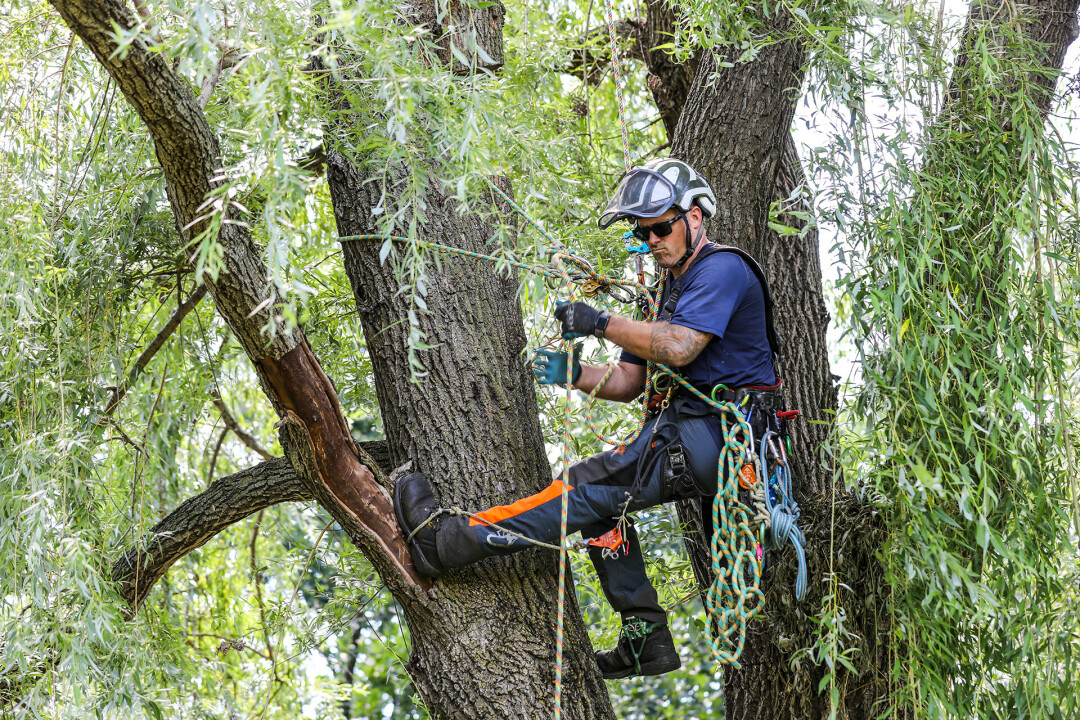
Beyond these initial apprehensions, Staudenmaier today reflected on the role of the LDO’s “simple permits,” to optimize enforcement of the tree mitigation ordinance. This permitting, today, aims to facilitate a more direct relationship between area tree servicers and the municipal forestry division – with the hope of easing the department’s workload.
It also aims to provide much-needed clarity on how the regulations differentiate between private residential lots and larger commercial ventures.
“Enforcement has been somewhat nascent,” Staudenmaier told Volume One this July. “We only have had a couple development projects so far that have fallen into the category of needing permitting.”
These commercial development projects, Staudenmaier added, were eye opening for the staff, noting “reliance on the developers to submit tree inventories has left something of a gap in numeration of tree values.”
It is difficult to get the message out that this is really a Land Development Ordinance and not just a tree ordinance. (Ordinary citizens) hear the need for permits – they think there are fees tied to it for remediation – and they become very cagey about doing routine tree work. –Matt Staudenmeier, City of Eau Claire Forester
In short, Staudenmaier explained while the inventory of high-value trees has remained static since October, ambiguities persist. Specifically, the LDO’s mandates on preservation and removal can encounter grey areas when applied to parcels exceeding one acre, or those that lack exemptions as outlined in the tree mitigation ordinance.
This affects tree care providers, too, as many of the area companies Staudenmaier’s department works alongside expressed worries they would need to secure permits for any tree removals done in the city – regardless of the trees’ condition or status.
“It is difficult to get the message out that this is really a Land Development Ordinance and not just a tree ordinance,” Staudenmaier said. “(Ordinary citizens) hear the need for permits – they think there are fees tied to it for remediation – and they become very cagey about doing routine tree work.”
“Basically, the ordinance is for building subdivisions or commercial property – though the majority of the questions have been from individual homeowners,” Staudenmaier continued.
Envisioned as a living document, the LDO outlines that the Eau Claire Plan Commission will be responsible for drafting regular advisory updates to both the Land Development Ordinance and the City’s Comprehensive Plan.
This model mirrors the City’s Capital Improvement Plan (CIP), where “opportunities for adding projects to the CIP usually come in the latter years of the plan where planning is still ongoing and financial priorities can more easily be adjusted.”
For questions on the Eau Claire Century Code Update and Land Development Ordinance, contact planning@eauclairewi.gov or 715-839-4914. The City of Eau Claire Forestry department can be reached at (715) 839-5039.