

Ever Heard Of 'Fibermaxxing' Or 'Proteinmaxxing'?
we chatted with local Registered Dietician Miranda Roberts about what people 'get wrong' about healthy eating, social media buzzwords in the food scene and more
Over the past two or so years, social media has fanned the firestorm of non-professional health advice around, among others, two things: protein and fiber.
It’s become such a craze – ever head of “fibermaxxing” or “proteinmaxxing?” – that nearly every media entity and dozens of health sciences education institutions has written about it: Johns Hopkins Bloomberg School of Public Health, the Associated Press, BBC, NPR, PBS, The New York Times, The Wall Street Journal, even Good Morning America.
The saying “take it with a grain of salt” should be applied to pretty much everything in the digital landscape, but it’s true that more and more people rely on those online resources for information.
With these observations in mind, we connected with Miranda Roberts, a registered dietician and the University of Wisconsin-Stout Polytechnic’s campus dietician, to talk about what people get “wrong” about healthy eating, protein intake and more.
As a dietician, what do most people often get wrong about eating healthy?
MR: “From my experience people often get information overload and become overwhelmed. This leads to people asking themselves things like, ‘can I pronounce this ingredient?’ or ‘I heard about this study that said this ingredient is dangerous.’ Those messages can lead to people becoming unnecessarily restrictive or give up on healthy habits altogether because eating starts to feel too complicated.

“One example I reference is the statement, ‘if you can’t pronounce it, don’t eat it.’ The ability to pronounce a word has nothing to do with its nutritional value. Apples, for example, contain fructose, magic acid, ascorbic acid, quercetin, catechin and cellulose. If you couldn’t pronounce one of those words, would you stop eating apples? How are you going to keep the doctor away? An unfamiliar word does not make it harmful.”
“I also think we have unintentionally assigned moral value to food. We talk about food as ‘good’ or ‘bad,’ but food is just food. Some foods are more nutrient dense than others, but having a slice of pizza doesn’t make you a bad person, just like eating a salad doesn’t make you a good person.”
“When I work with clients, I focus on what we can add rather than what we need to take away. Instead of telling them to stop eating pizza, we might add a piece of fruit or a side salad. Instead of replacing all their pasta with whole wheat versions, we might start with a 50/50 mix of regular and whole wheat. If someone enjoys smoothies, I’ll suggest adding spinach or kale.”
“Small, sustainable changes are much more likely to last. Healthy eating shouldn’t be about fear or perfections. It should be about building habits that are enjoyable and sustainable.”
I also think we unintentionally assigned moral value to food. We talk about food as "good" or "bad," but food is just food. Some foods are more nutrient dense than others, but having a slice of pizza doesn't make you a bad person, just like eating a salad doesn't make you a good person. –Miranda Roberts, registered dietician
You touched on this – buzzwords like ‘protein’ and ‘fiber’ online – in your recent class at UW-Stout Polytechnic, “Protein Done Right: Build Meals, Bust Diet Myths.” Can you share insights into what protein and fiber intake should be for the average adult?
MR: “Unlike protein, fiber is one of those nutrients most people are not getting enough of. Women need about 25g of fiber daily and men need about 38g of fiber daily. Fiber can come from a variety of places: fruit, veggies, whole wheat/whole grain breads and pasts – including whole grain gluten-free options – oatmeal, nuts, seeds and beans.”
“My suggested fiber hacks to increase your fiber needs are: start with the nutrition label. Look for 5g of fiber per serving. When buying breads, pastas or tortillas, make sure that the first ingredient is whole wheat flour – not enriched wheat flour.”
“Start your day off with overnight oats and fruit or yogurt parfait with fruit, granola and chia seeds. Make easy swaps like whole wheat tortillas or whole wheat pasta when you can. Keep the skin on as many fruits and veggies as you can since most of the fiber is in or just under the skin!”
“Lastly, boost your snack with foods like lightly buttered popcorn, nuts/seeds, fresh fruits and veggies with your favorite dip.”
“Protein is a little more complicated as far as needs go. Your needs can depend on activity level, age, and whether you are recovering from an injury or surgery. For most sedentary adults, you only need 0.8 g/kg of (your) bodyweight. However, if you are an active individual, 65 years or older, or are recovering from surgery or injury, you could benefit from 1.2g-2g/kg (of your) bodyweight per day. That’s a wide range, which is why working with a dietician can help you find your individual needs.”
Protein is a little more complicated as far as needs go. Your needs can depend on activity level, age, and whether you are recovering from an injury or surgery. –Miranda Roberts, registered dietician
“If you don’t know your exact protein target, don’t worry. You can still build balanced meals that provide plenty of protein by following some simple guidelines: Make sure that all meals contain a source of protein, doesn’t matter if it is plant-based or animal-based. Aim for 20-30g of protein per meal and 10-15g of protein per snack.
“Some of my favorite ways to sneak in more protein are incorporating cottage cheese, Greek yogurt, string cheese, eggs and edamame. And don’t forget about foods like beans and whole wheat products – they provide protein along with fiber!”
When someone is looking to make a meal for themselves or a family, what does a balanced meal actually look like in today’s age?
MR: “I encourage people to think about four simple pieces. First, half of your plate should be fruits and/or vegetables. These provide vitamins, minerals, fiber and antioxidants that support overall health. Protein gets a lot of attention, but fruits and vegetables are still some of the most nutritious foods we can eat.”
“Second, a quarter of your plate should be a protein source. This might be chicken, fish, eggs, Greek yogurt, cottage cheese, tofu, beans, lentils or another protein-rich food. Protein helps support muscle maintenance, recovery, immune function and it can help meals feel more satisfying.
Third, your final quarter of the plate should include carbohydrates. Carbohydrates are your body’s preferred source of energy. Despite what some corners of the internet might tell you, carbs are not the enemy. Food like potatoes, rice, pasta, bread, oats and other grains help fuel your brain, muscles and daily activities.”
“And finally, add a source of healthy fat. It can be as simple as sautéing veggies in olive oil. Fat helps with the absorption of certain vitamins, supports hormone production and helps meals feel satisfying. Examples include nuts, seeds, avocado, olive oil and fatty fish.
“When you put all four of these pieces together, you have the foundation of a balanced meal. It doesn’t have to be perfect, and every meal doesn’t need to look exactly the same. But if you’re consistently including these components, you’re probably doing a lot better than you think!”
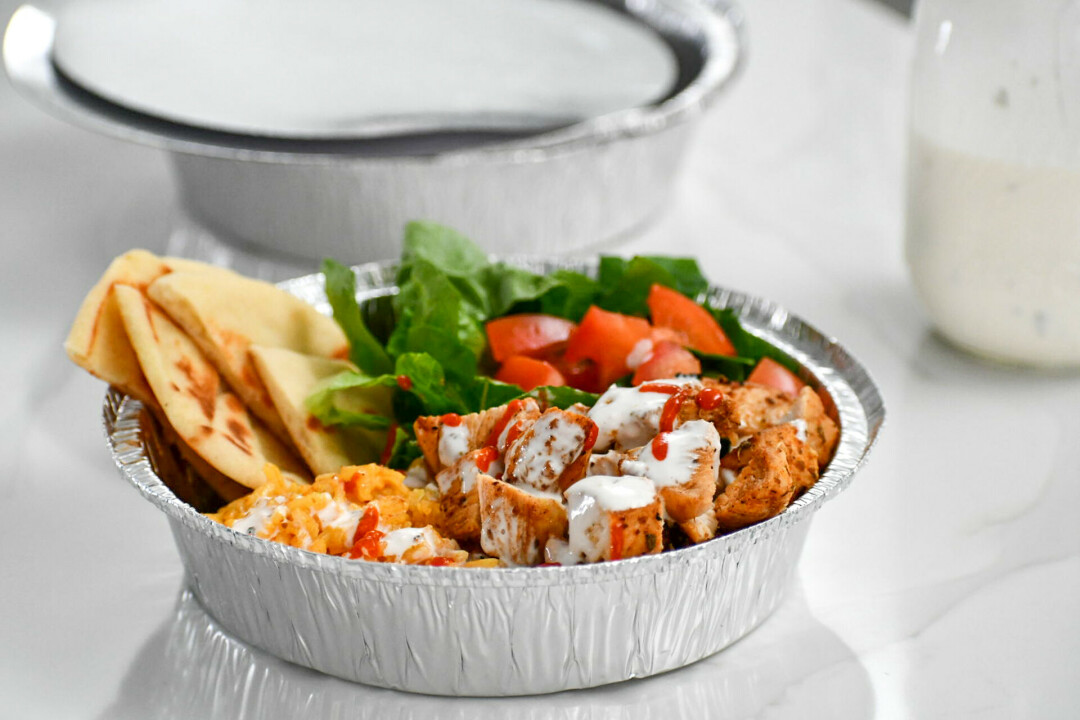
“I love a good ‘bowl’ recipe: poke bowls, Buddha bowls, burrito bowls,” Roberts told Volume One. “They are an easy way to get all four components for a balanced meal, and they are so versatile! You can adjust to your preferred protein, grain, and veggies. But my favorite bowl recipe is a Halal Cart Chicken Bowl. The recipe below serves four.”
Ingredients
- Chicken Marinade
- 2.5 lbs of chicken breast or thigh (boneless, skinless), cut into 1-inch cubes
- Shawarma seasoning – to taste
- 2 tablespoons of olive oil
- White Sauce
- 1/4 cup light Mayo
- 1/4 cup plain Green yogurt
- 1/4 cup light sour cream
- 1/2 tablespoon white vinegar
- 1/2 of 1 lemon's juice
- 4 garlic cloves, minced
- Salt and pepper – to taste
- Water, to thin out as necessary
- Yellow Rice
- 2 cups of Basmati rice, rinsed – or rice of choice
- 1.5 tablespoons of olive oil
- 1 teaspoon of salt
- 1/2 teaspoon of turmeric
- 3.5 cups of chicken broth
- Other/Optional
- Tomatoes, diced
- Lettuce, chopper/shredded
- Other optional veggies include cucumbers, shredded carrots or red onion
- Sriracha
Cooking Instructions
- Combine chicken with the marinade ingredients and refrigerate for at least 1 hour or overnight.
- While chicken marinates, prepare the white sauce. Mix all the sauce ingredients together, adding water a little at a time until it reaches a smooth, pourable consistency. Cover and refrigerate until ready to serve.
- About 30 minutes before serving, start the rice. Add olive oil in a pot over medium heat, then stir in rice and cook for 2-3 minutes to toast it. Add the salt and turmeric, followed by the broth. Bring to a boil, reduce to a simmer, cover and cook for 20 minutes. Once the rice is tender, fluff with a fork.
- As the rice cooks, prepare the chicken. Heat a large nonstick skillet over high heat and cook the chicken for 8-10 minutes until fully cooked (165° F) and no longer pink in the middle.
- To serve, place rice in a bowl. Top with cooked chicken, shredded lettuce, tomatoes and any optional veggies. Finish with a drizzle of the white sauce (and sriracha, if desired) and serve.
For healthcare recommendations specific to your body and lifestyle, seek a professional provider's advice • This Q&A with Miranda Roberts, a registered dietician who works as the University of Wisconsin-Stout Polytechnic's campus dietician, has been lightly edited for brevity.